1- OVERVIEW :
ASFT making airport runways safer
Friction is vital for an efficient flow
of people and goods. Airplanes depend on friction between runway and
tires. When a few hundred tons of aircraft is landing, sufficient friction
levels are needed to halt the aircraft before the end of the landing strip.
Friction is also needed to control and steer the
aircraft during landing and takeoff. Both ICAO and FAA require commercial
airports to know the friction level on the runway and have full control over
the landing and take-off conditions.
There is an operational need for reliable and
uniform information concerning the friction characteristics of runways.
Contaminants such as rubber deposits, dust particles, jet fuel, oil spillage,
water, snow, ice and slush all cause friction loss.
Airport Surface Friction Tester (ASFT) is the
world's leading manufacturer of Continuous Friction Measuring Equipment (CFME).
ASFT friction measuring equipment is fully approved by UK CAA CAP683, Swedish
CAA, FAA and ICAO. We supply friction measuring equipment and weather
monitoring systems that meet the need of any airport, and our CFME are
currently in use at more than 300 airports around the world.
ASFT
making roads safer
Friction is vital for an efficient flow
of people and goods. Motorcycles, cars, trucks & buses all depend
on friction between road and tires. Many road accidents occur unnecessary due
to a lack of understanding of or interest in surface friction. This can be
greatly reduced by implementing simple procedures with a reliable surface
friction testing program the year around – regardless of season.
2- TECHNOLOGY :
ASFT Continuous Friction Measuring Equipment (CFME) is a
friction test method operating with fixed longitudinal slip of about 13 % on
the test wheel. This is also referred to as skiddometer principle or fixed slip
devices. The advantage of a slip measurement is that it can provide a
continuous record of the friction.
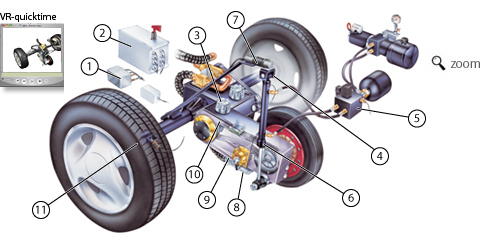
The rear axle has a third smaller wheel on an arm. This is
the measuring wheel. The tyre has a material, a shape and a tread which closely
resembles those of a normal tyre. This gives friction readings that closely
correlate with true friction values that you get from a vehicle in operation.
The vertical load on the measuring wheel should be 1400N,
and to achieve this we use hydraulic pressure to generate the vertical load and
through the vertical transducer we can monitor (and calculate with) the actual
load on the measuring wheel at any given moment. The measuring wheel is
connected to the rear axle with a chain transmission. The gear ratio provides a
constant 13 % slip. As the measuring wheel has a smaller diameter than the rear
wheel, the chain will be tensioned when the vehicle moves.
This tension is proportional to the friction number. The
torque transducer (T-sensor) transforms the tension into analogous signals,
which are used in the calculation of the friction values. The friction value is
then presented in various ways.
ASFT
CFME can also be equipped with a self wetting or water system for simulation of
rain on the road infrastructure. The standard tank sizes are 500 and 700 litre,
but any size tank can be costumed made. There is no uniformed regulation among
the different road administrations for the depth of the water film. Our system
is therefore equipped with a water pump, and the operator can electronically
adjust the depth of the water film from 0.1 to 5.0 mm.
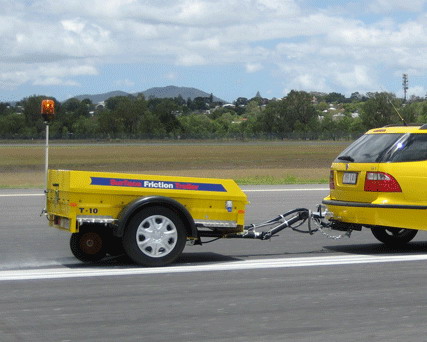
3- EQUIPMENT3.1- T-10 Trailer
3.2- T-5 Trailer

3.3 – T2GO